Python in Heliophysics Community
Promoting and facilitating the use and development of Python for Heliophysics.
A community knowledge base for performing heliophysics research in Python, aiming to provide a variety of tutorials, resources, a list of useful packages, general discussion, and advice.
Our Mission Statement
Facilitate scientific discovery by promoting the use and development of sustainable open-source Python software across the solar and space physics community; improving communication and collaboration between disciplines, developers, and users; establishing and maintaining development standards; and fostering interoperability and reproducibility.
Our Strategic Goals
- Coordinate development across projects to minimize duplication of effort and share lessons learned
- Promote best practices for software development, documentation, testing, and dissemination
- Increase community awareness of and participation in projects
- Promote scientific reproducibility and software sustainability
- Educate and support the Python user community in solar and space physics
- Foster an open-source Python software ecosystem for heliophysics research and education
- Identify community needs for future development
- Identify and pursue opportunities for financial support
- Enable efficient interdisciplinary research
Calendar
PyHC meets in person twice yearly. Telecons are held approximately every two weeks on Mondays at 09:00 AM Mountain time, but this can fluctuate depending on holidays, conferences, etc. Meetings and telecon times are available on our Google Calendar:
News
Announcing PHEP 4
PyHC has formally adopted PHEP 4: PyHC Package Tiering! This new Process PHEP establishes a three-tier structure for PyHC packages—Gold, Silver, and Bronze—that will replace the current “Core,” “Other,” and “Unevaluated” groupings.
Tiering preserves PyHC as an inclusive collection of Heliophysics-relevant Python packages while making it clearer which packages have completed additional review, standards compliance, and community-support steps. The tiers give users a better signal of how robust and maintained each package is, and higher tiers carry more benefits: summer school tutorial invitations, priority for inclusion in broader PyHC efforts like the PyHC Environment and PyHC-Chat, standards-compliance assistance, and consideration for conference travel funding (depending on tier and available PyHC resources).
Adopting PHEP 4 kicks off a process to re-designate every PyHC package into the new tiers. A few pieces of groundwork need to be in place first, though, including finalizing the related PyHC–pyOpenSci review PHEPs and standing up the Technical Steering Committee that performs reviews. As a result, there will be a delay before we launch the re-designation process. When we do begin, we’ll announce it officially (by email and at a telecon) and follow the timeline laid out in PHEP 4 from that point. No action is needed from package maintainers right now.
To learn more, read the full PHEP 4 document. Thanks to Julie Barnum for authoring PHEP 4, and to everyone who shaped it through community discussion. Questions or feedback? Join the discussion on PyHC’s mailing list or Slack!
Announcing PHEP 3
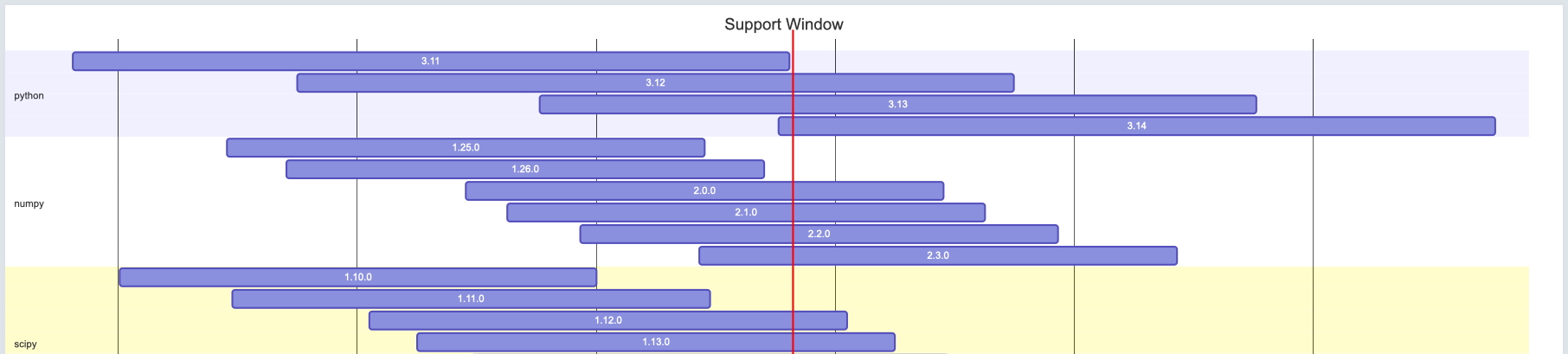
PyHC has formally adopted PHEP 3: PyHC Python & Upstream Package Support Policy! This new PHEP establishes a unified, time-based approach to dependency support across the PyHC ecosystem, bringing our community into alignment with the broader Scientific Python ecosystem.
PHEP 3 recommends that all PyHC packages adopt the following support policy, based on SPEC 0:
- Support Python versions for 36 months (3 years) after their initial release
- Support core Scientific Python packages for 24 months (2 years) after their initial release
- Adopt new versions within 6 months of their release
This policy applies to Python itself and to the upstream core Scientific Python packages: NumPy, SciPy, Matplotlib, pandas, scikit-image, NetworkX, scikit-learn, xarray, IPython, and Zarr.
To learn more, read the full PHEP 3 document. We will also maintain a PHEP 3 Support Schedule page with a graphical timeline and quarterly reminders to help package maintainers stay on track. Questions or feedback? Join the discussion on PyHC’s mailing list or Slack!
Introducing the PyHC Documentation Hub!
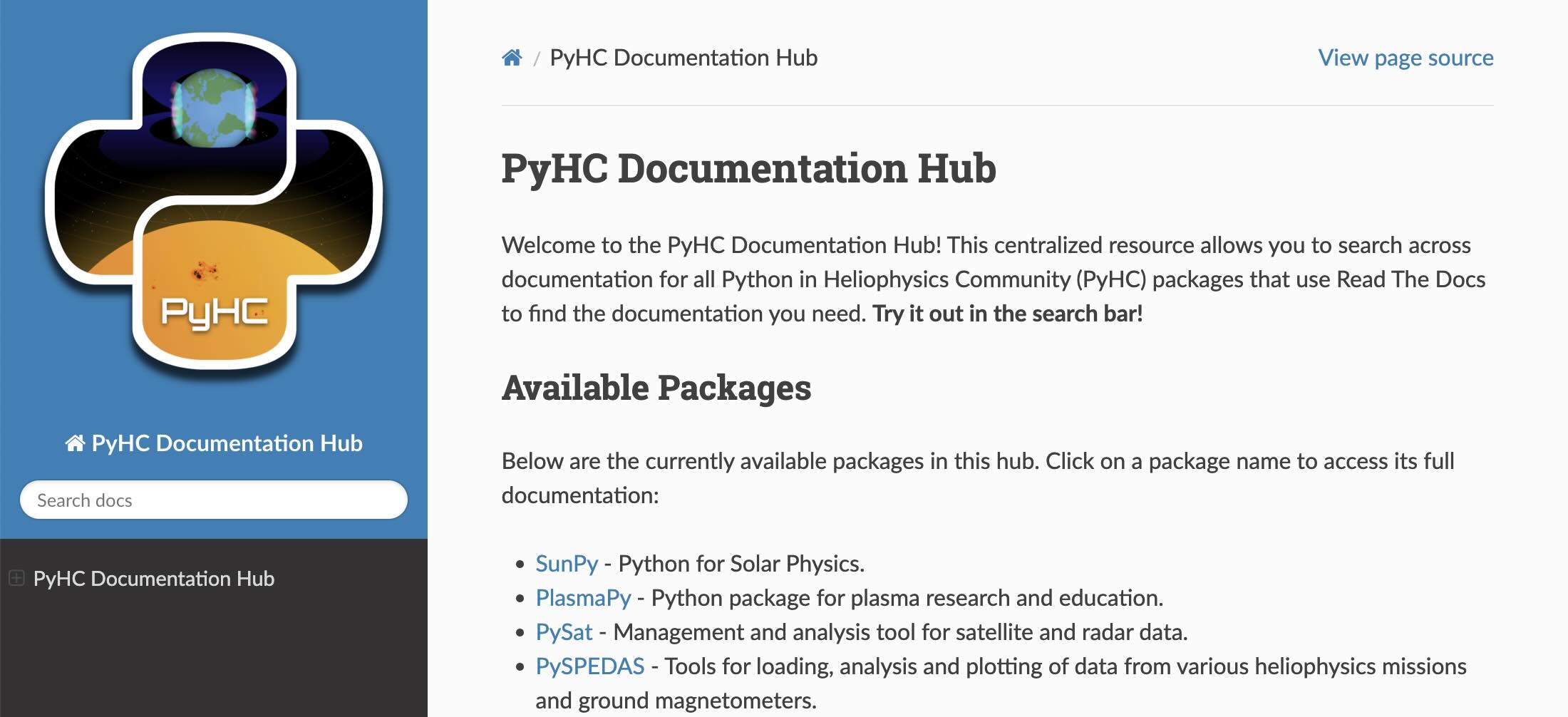
We’re excited to announce the launch of the PyHC Documentation Hub, now available at pyhc.org/pyhc-docs. This centralized resource simplifies how you search across documentation for all PyHC packages that use Read The Docs. No more switching between dozens of disparate package websites to find the information you need. The Hub not only links all packages together in one convenient place but also provides a powerful search interface that organizes results by package for easy navigation. Find documentation faster than ever—we hope you find it useful. Try it out today!
subscribe via RSS