Blog
subscribe via RSS
Announcing PHEP 4
PyHC has formally adopted PHEP 4: PyHC Package Tiering! This new Process PHEP establishes a three-tier structure for PyHC packages—Gold, Silver, and Bronze—that will replace the current “Core,” “Other,” and “Unevaluated” groupings.
Tiering preserves PyHC as an inclusive collection of Heliophysics-relevant Python packages while making it clearer which packages have completed additional review, standards compliance, and community-support steps. The tiers give users a better signal of how robust and maintained each package is, and higher tiers carry more benefits: summer school tutorial invitations, priority for inclusion in broader PyHC efforts like the PyHC Environment and PyHC-Chat, standards-compliance assistance, and consideration for conference travel funding (depending on tier and available PyHC resources).
Adopting PHEP 4 kicks off a process to re-designate every PyHC package into the new tiers. A few pieces of groundwork need to be in place first, though, including finalizing the related PyHC–pyOpenSci review PHEPs and standing up the Technical Steering Committee that performs reviews. As a result, there will be a delay before we launch the re-designation process. When we do begin, we’ll announce it officially (by email and at a telecon) and follow the timeline laid out in PHEP 4 from that point. No action is needed from package maintainers right now.
To learn more, read the full PHEP 4 document. Thanks to Julie Barnum for authoring PHEP 4, and to everyone who shaped it through community discussion. Questions or feedback? Join the discussion on PyHC’s mailing list or Slack!
Announcing PHEP 3
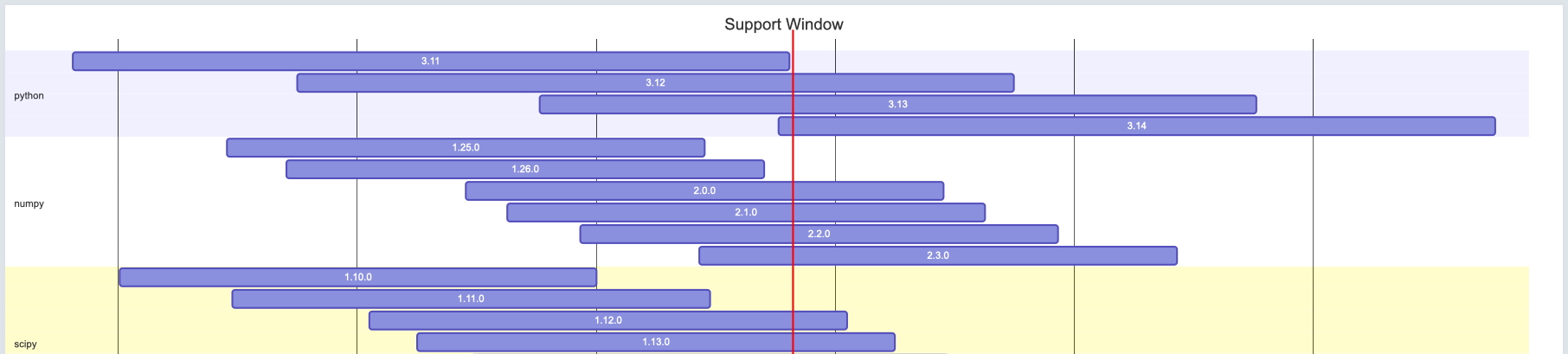
PyHC has formally adopted PHEP 3: PyHC Python & Upstream Package Support Policy! This new PHEP establishes a unified, time-based approach to dependency support across the PyHC ecosystem, bringing our community into alignment with the broader Scientific Python ecosystem.
PHEP 3 recommends that all PyHC packages adopt the following support policy, based on SPEC 0:
- Support Python versions for 36 months (3 years) after their initial release
- Support core Scientific Python packages for 24 months (2 years) after their initial release
- Adopt new versions within 6 months of their release
This policy applies to Python itself and to the upstream core Scientific Python packages: NumPy, SciPy, Matplotlib, pandas, scikit-image, NetworkX, scikit-learn, xarray, IPython, and Zarr.
To learn more, read the full PHEP 3 document. We will also maintain a PHEP 3 Support Schedule page with a graphical timeline and quarterly reminders to help package maintainers stay on track. Questions or feedback? Join the discussion on PyHC’s mailing list or Slack!
Introducing the PyHC Documentation Hub!
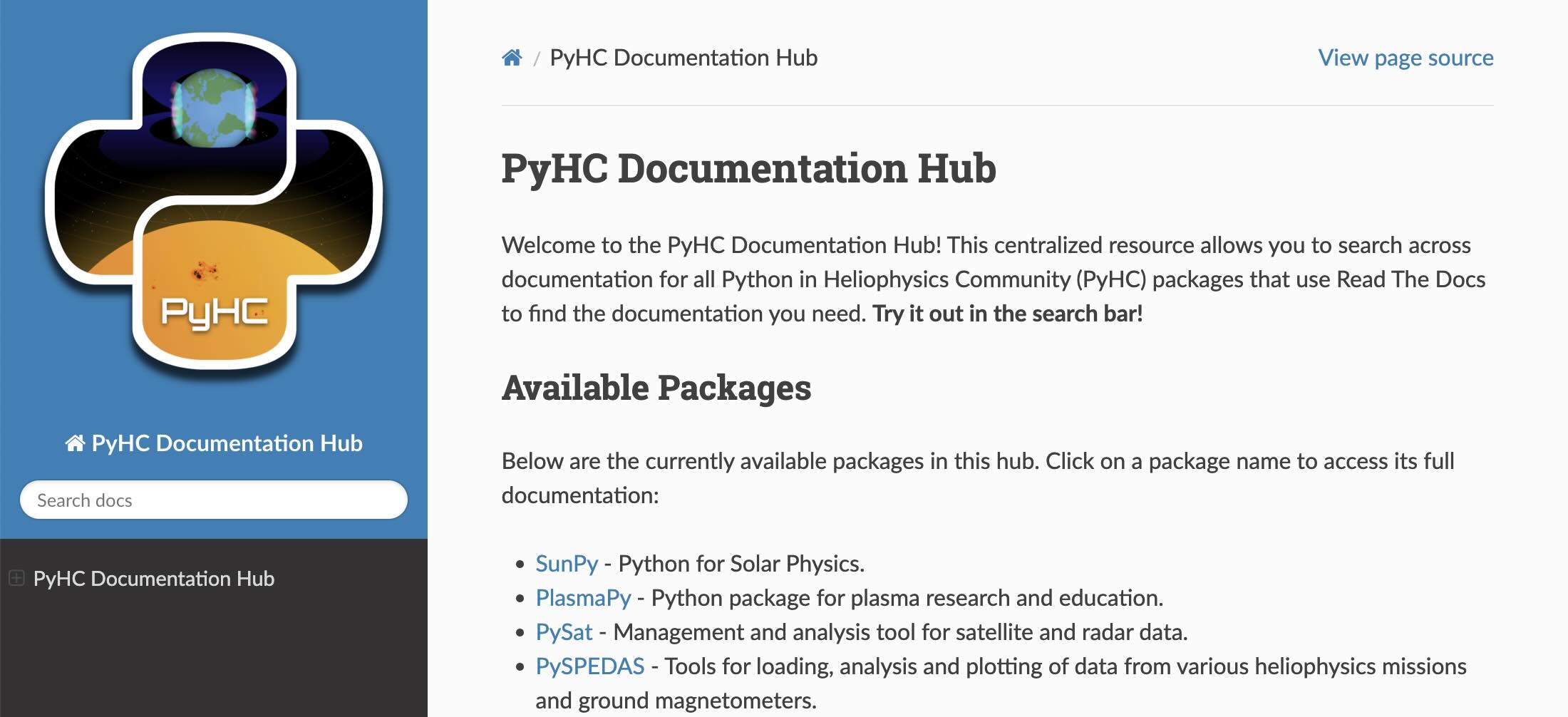
We’re excited to announce the launch of the PyHC Documentation Hub, now available at pyhc.org/pyhc-docs. This centralized resource simplifies how you search across documentation for all PyHC packages that use Read The Docs. No more switching between dozens of disparate package websites to find the information you need. The Hub not only links all packages together in one convenient place but also provides a powerful search interface that organizes results by package for easy navigation. Find documentation faster than ever—we hope you find it useful. Try it out today!
Poster Abstract Submission Open for the PyHC 2024 Summer School
As a reminder, the Python in Heliophysics Community (PyHC) 2024 Summer School is set to take place Monday, May 20th to Friday, May 24th at the prestigious Laboratory for Atmospheric and Space Physics (LASP) in scenic Boulder, Colorado, USA and online on Zoom. This year’s Summer School builds on the foundational success of its predecessor, offering an even deeper dive into the rich ecosystem of Heliophysics Python packages. Open to undergraduate and graduate students, early career scientists, and anyone eager to deepen their understanding of Python in the Heliophysics and Space Weather disciplines, this program promises a mix of in-depth tutorials, engaging demos, and hands-on sessions, delivered by some of the field’s leading experts. If you have not yet registered for the summer school, it is free to do so and a link for it can be located on the summer school’s web page. You’ll also find there a link to suggesting housing, NSF travel support applications, specific location, the agenda, and other important information.
If you plan to attend the PyHC 2024 summer school on site in Boulder, CO at LASP, and are interested in presenting on your work within Heliophysics/Space Physics and Python, the summer school poster session is your best bet! Bonus points if you can show work you’ve done that leverages the PyHC ecosystem. We have created a Google form to which you can submit your abstracts for the poster session, which will help the organizing committee adequately plan for the poster session, and ensure all submissions are on topic.
Submit PyHC 2024 summer school poster abstracts here. Deadline for abstract submission is Monday, May 6th, 2024 at 11:59 PM MT.
NSF Travel Support for the PyHC 2024 Summer School
The Python in Heliophysics Community (PyHC) is thrilled to announce that we were awarded $50k of NSF travel support to provide to selected attendees of the PyHC 2024 summer school! Per NSF policy, only US citizens and those with lawful permanent resident (LPR) status are eligible for the stipend.
Travel support applications will be vetted and approved by the summer school planning committee. Applications will be scored on need (whether the travel grant strongly determines their ability to attend onsite), career stage (student, post-doctoral, early career, or within 5 years of most recent degree given preference), and equity (ensuring travel funds are disbursed to multiple institutions, rather than focusing on large cadres from the same institution).
Funding specifications: Once applications have been reviewed, we will award flat-rate travel stipends of $2000 - $2500 (depending on home institute location) to selected attendees. These awards will be sent out as reimbursements for the meeting, therefore the attendee will have to float the cost up to that point.
Apply for the NSF-sponsored travel funding here. Applications are due by Monday, April 29th, 2024.